
Blog › Careers
Comparison guide · Coding vs billing
Medical Coding vs Medical Billing Difference: Roles, Skills and Career Scope
Medical coders turn a doctor’s documentation into codes. Medical billers use those codes to claim, chase and collect payment. This guide compares the two jobs side by side, follows one patient visit from code to payment, and helps you decide which path fits you.
✍️ Medical Coding Masters editorial team
JUMP TO WHAT YOU NEED
Questions this guide answers
⚖️ The core difference in one table
→
🔄 How a claim travels from code to payment
→
🎓 Skills and certifications for each path
→
🧭 Which path should you choose?
→
ON THIS PAGE
Side-by-side table Claim journey Denials: who owns what Skills and mindset Certifications Career growth Which to choose FAQsPrefer a guided path?
Our trainers help you build the skills that lead to a better first offer. Sit in on a class for free.
Book a free demoMedical Coding vs Medical Billing
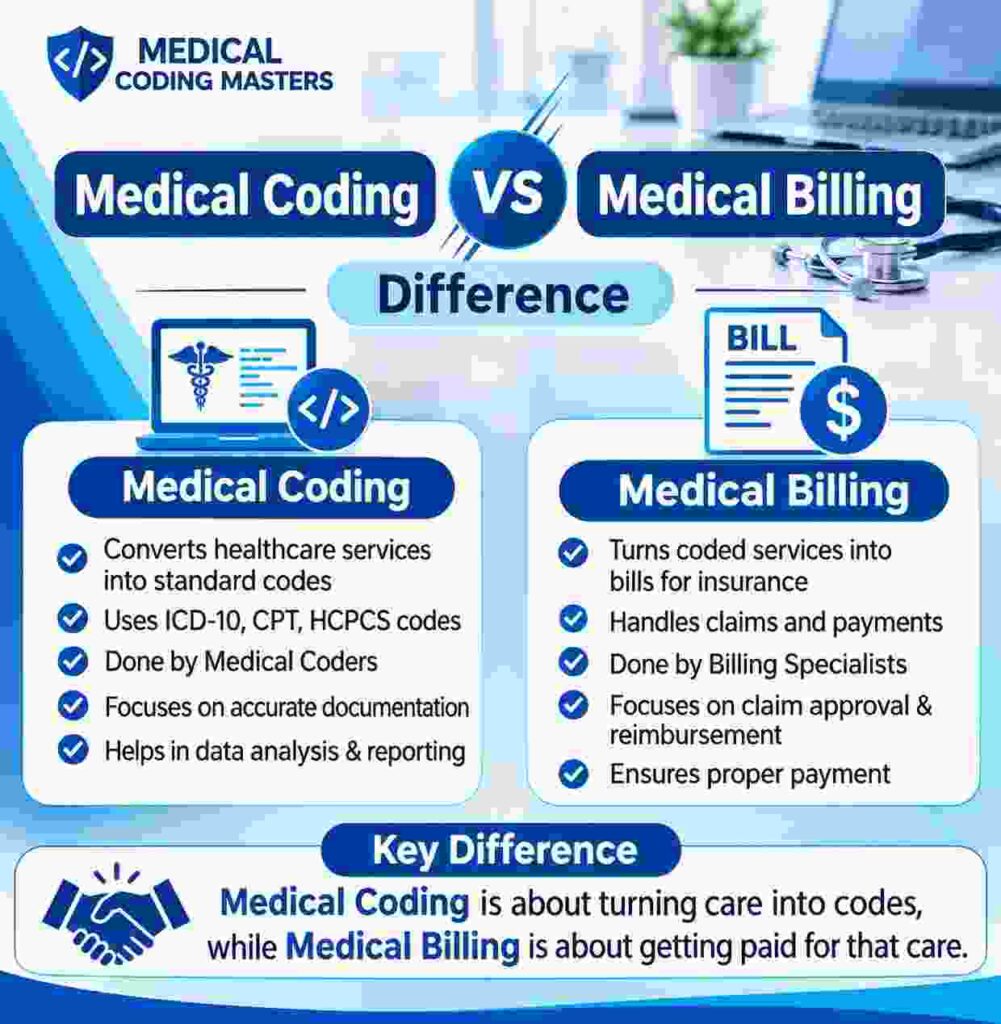
Medical coding turns what happened during a patient visit into standard codes. Medical billing uses those codes to get the visit paid. One job ends where the other begins, which is why people often mix them up.
A simple way to remember it: the coder works from the medical record, while the biller works from the claim. The coder asks, “What does this chart say, and which codes does it support?” The biller asks, “Has this claim reached the right payer, and has the money come back?”
In many healthcare-BPO and RCM teams that serve US clients, the two roles sit in separate teams but depend on each other every day. Knowing both sides makes you a stronger candidate for either. If you need the definition of coding first, read our guide to what is medical coding, then come back here for the comparison.
Medical Coding vs Medical Billing Difference
Two Jobs, Defined in Plain Language
Medical coding starts once a provider’s documentation is complete and ends when diagnosis, procedure and service codes are assigned and checked. The coder’s product is a set of codes that the record supports. Coders rarely speak to payers or patients.
Medical billing starts when coded services are ready to be charged and ends when the account is settled: the payer has paid, the patient has been billed their share, or a balance has been adjusted under policy. The biller’s product is a paid, or correctly resolved, claim.
A useful rule: coders protect accuracy, billers protect cash flow, and both protect compliance. If you want the billing side in depth, see our medical billing training in Hyderabad.
Medical Coding vs Medical Billing: Side-by-Side Comparison
Here is the medical coding vs medical billing difference across the factors that matter most.
Factor | Medical Coding | Medical Billing |
Question it answers | What does the record support? | What is owed, and by whom? |
Starting material | Clinical notes, operative reports, discharge summaries | Coded charges, patient demographics and insurance details |
End product | Validated ICD-10-CM, CPT and HCPCS codes | A submitted claim, posted payment, resolved denial or patient statement |
Who they deal with | Mostly providers (documentation queries) and quality teams | Payers, clearinghouses, patients and the provider’s front office |
Work rhythm | Heads-down chart reading against productivity and accuracy targets | Queue-based follow-up through claims, payer portals, calls and appeals |
Core knowledge | Terminology, anatomy, code sets and official guidelines | Payer rules, claim forms, adjustment reasons and patient-responsibility rules |
Typical tools | Encoders, code books, EHR/EMR systems | Billing or practice-management software, clearinghouse and payer portals |
How quality is measured | Coding accuracy in audits | Clean-claim rate, denial rate, days in accounts receivable |
Common entry credentials | CPC, CCA, CCS | CPB, CBCS |
Typical growth path | Senior coder, auditor, trainer, coding manager | A/R analyst, denial specialist, billing supervisor, RCM manager |
These are general patterns. Job titles vary by employer, so read each job description to see which side of the revenue cycle a role actually covers.
Not sure which desk is yours?
Sit in on a free demo class and ask our trainers which path suits your background.
How One Patient Visit Moves From Code to Payment
Here is one illustrative outpatient visit, followed from the front desk to the final payment. The codes mentioned only show the idea. Real code selection depends on the full documentation and the current code books.
A patient seeks medical attention at a clinic due to an ongoing cough and fever.
The doctor documents pneumonia, orders a two-view chest X-ray and records the consultation.
- Registration (front office or billing): patient details are captured and insurance eligibility is checked. Errors here cause denials that no coder can fix.
- Documentation (provider): the doctor completes the note, including the diagnosis and the services performed.
- Coding (coder): the coder reads the note and assigns a diagnosis code (for example, J18.9 for pneumonia, unspecified organism) plus service codes for the office visit and the two-view chest X-ray (CPT 71046). Each service is linked to a diagnosis that supports it.
- Charge entry (biller): the coded services are entered as charges using the practice’s fee schedule.
- Claim check and submission (biller): the claim, built on the CMS-1500 format and sent electronically as an 837P file, is checked for errors and sent to the payer, usually through a clearinghouse.
- Payer decision: the insurer pays, reduces or denies the claim.
- Payment posting (biller): payments and adjustments from the remittance advice are posted to the patient’s account.
- Denial follow-up (biller, with the coder if a code is involved): rejected claims are corrected, appealed or written off under policy.
- Patient statement (biller): any remaining patient share is billed.
Notice how the coder’s work sits in a single step, while the biller’s work covers most of the rest. Billers handle steps 4 to 9 in specialised software; see our overview of the top software tools used for medical billing services to know what to expect.
Who Owns the Problem When a Claim Is Denied?
Not every denial is a coding mistake, and not every denial is a billing mistake. Sorting the cause correctly saves hours of rework. This table shows where common denial reasons usually trace back to.
Common denial reason | Usually traced to | Typical fix |
Diagnosis not specific enough, or not supported by the note | Coding and documentation | Query the provider; recode if the documentation allows |
Missing or incorrect modifier | Coding | Review modifier rules and send a corrected claim |
Service not supported by the linked diagnosis (medical necessity) | Coding | Re-check diagnosis-to-service linking; appeal with documentation if justified |
Name, policy number or date of birth mismatch | Registration and billing | Correct the demographics and resubmit |
Coverage inactive, or wrong payer billed | Eligibility check and billing | Verify eligibility and bill the correct payer |
Claim filed after the payer’s deadline | Billing | Appeal with proof of timely filing if you have it; prevention is the real fix |
Duplicate claim | Billing | Check claim status before resubmitting |
Prior authorisation missing | Front office and billing | Obtain authorisation, or appeal where the payer allows it |
Experienced billers learn to read a denial reason and send it to the right desk. Experienced coders learn which of their errors come back as denials.
Curious how coding accuracy affects claims?
Ask our trainers about chart-to-claim examples in a free demo class.
Skills and Mindset: Which Job Suits You?
The two jobs reward different working styles, even though both need accuracy and confidentiality.
Coding suits you if you
- are comfortable reading dense clinical text for long stretches
- like rules, and enjoy proving why a code is right from the documentation
- can work independently with limited conversation during the day
- are willing to learn terminology, anatomy and guidelines from scratch
Billing suits you if you
- stay persistent when a claim needs several follow-ups
- can write and speak clear English for payer communication
- are comfortable with numbers, ageing reports and spreadsheets
- stay calm when claims are rejected and need to be reworked
Both paths need
- respect for patient-data confidentiality
- a working understanding of how health insurance pays
- basic computer skills and steady attention to detail
To see how coding skills build up module by module, browse our medical coding course syllabus.
Certifications for Each Path
Coding and billing have separate credentials, and some employers like candidates who hold one from each side.
Path | Credential | Issued by | Generally suits |
Coding | CPC | AAPC | Outpatient and physician-office coding |
Coding | CCA | AHIMA | Entry-level coding credential |
Coding | CCS | AHIMA | Hospital inpatient coding |
Billing | CPB | AAPC | Billing, claims, and payer and patient collections |
Billing and coding | CBCS | NHA | Entry-level roles that mix billing and coding |
A certificate is not a licence, and it does not guarantee a job. Employers decide which credential they prefer, so check each job description. Confirm eligibility, exam format and fees on the issuing body’s own pages: AAPC’s CPC page, AAPC’s CPB page and AHIMA’s certification overview.
Planning for CPC, CCS or CCA?
Ask about mock tests and certification guidance before you decide.
Career Growth: Where Each Path Leads
Both tracks start at entry level and meet again in revenue-cycle management. Neither path automatically pays more. Pay depends on certification, specialty, employer, shift and the accuracy or collections record you can show.
Stage | Coding track | Billing track |
Entry | Trainee or associate coder | Billing executive or claims associate |
Mid-level | Certified coder or specialty coder | Payment-posting or A/R analyst, denial specialist |
Senior | Auditor, quality analyst or trainer | Senior A/R analyst or billing team lead |
Leadership | Coding manager | Billing or RCM manager |
For pay ranges, see our guides to medical coding salaries in Hyderabad and medical billing salary in India. To see who is hiring, read about medical coding jobs in Hyderabad and medical billing jobs in Hyderabad. For the full coding ladder, follow the medical coding career path.
Which One Should You Choose?
Pick the path that matches how you like to work, not the one that sounds more impressive.
Choose medical coding if
- you enjoy interpreting documentation and applying guidelines
- you prefer focused solo work over calls and follow-ups
- you are aiming for audit, specialty or training roles later
Choose medical billing if
- you like solving payment problems and chasing claims to closure
- you are comfortable communicating with payers
- you are aiming for denial management, A/R or RCM leadership
Learn both if
- you want to work in smaller practices where roles are combined
- you plan to move into revenue-cycle management
Still undecided? Skim the medical coding interview questions and the medical billing interview questions side by side. The set you enjoy working through often points to the right desk. If coding is your pick, our medical coding course in Hyderabad is the place to begin.
Ready to pick your path?
Talk to a counsellor about coding, billing and batch timings.
Myths About Medical Coding and Medical Billing
Four ideas keep misleading beginners.
- “Billing is just data entry.” Billers read payer rules, decode denials and write appeals. Entry is the smallest part of the job.
- “Coding is memorising codes.” Coders rely on code books, encoders and guidelines. The skill is matching documentation to the right code, not recalling numbers.
- “You must choose one forever.” Many professionals move between coding, billing, auditing and RCM roles as they gain experience.
- “AI will make one of them disappear.” Automation is taking over routine tasks, while exceptions, audits and denial handling still need people. We cover this in our guide to generative AI in medical coding and medical billing.
Key Takeaways
- Medical coding converts clinical documentation into ICD-10-CM, CPT and HCPCS codes; medical billing uses those codes to claim, collect and resolve payment.
- The coder works from the medical record, and the biller works from the claim.
- Coding errors and billing errors both cause denials, but they need different fixes and different desks.
- Coding has its own credentials (CPC, CCA, CCS) and so does billing (CPB, CBCS).
- Neither path automatically pays more; certification, specialty and employer matter more than the label.
- Many people start in one path and later learn the other, especially for RCM leadership.
Conclusion
The medical coding vs medical billing difference comes down to where each job sits in the revenue cycle. Coding turns documented care into accurate codes. Billing turns those codes into a paid claim. Each depends on the other’s accuracy, and each offers a clear career ladder.
Choose the path that fits how you like to work, check each employer’s requirements, and keep your expectations realistic: training and certification improve your chances but cannot guarantee a job. When you are ready to compare costs and plan your learning, see our guide to medical coding course fees in Hyderabad.
Ready to start learning?
The next batch starts on 1 November 2026.
FAQ
What is the main difference between medical coding and medical billing?
Medical coding assigns standard codes to documented care. Medical billing uses those codes to prepare claims, collect payment from payers and patients, and resolve denials.
Which is easier to learn, medical coding or medical billing?
It depends on your strengths. Coding has a steeper start because of terminology, anatomy and guidelines. Billing is learned through payer rules and claim handling. Neither is easy to do well.
Do medical billers need to know medical codes?
They need working familiarity, enough to recognise codes and modifiers on a claim and understand denial reasons. They usually do not assign codes from charts.
Can one person work as both a coder and a biller?
Yes. Smaller practices often combine the roles, while larger RCM companies usually separate them. Credentials exist for both sides.
Do I need a medical background for either career?
Not to begin training. Life-science, nursing or pharmacy backgrounds can help with coding, but employer requirements vary, so check each job description.
Which pays more, coding or billing?
Neither pays more in every case. Pay depends on certification, specialty, employer, shift and your proven accuracy or collections record.
Can a medical biller become a medical coder?
Yes. Billers already understand claims and denials. They need to add terminology, anatomy, code-set knowledge and, usually, a coding credential.
Is certification required for coding and billing jobs?
Not always, but many employers prefer or require one. CPC, CCA and CCS are common on the coding side, and CPB and CBCS on the billing side.
Which should a fresher start with?
Start with the one that matches your working style and the openings you see. Both appear in revenue-cycle hiring, but availability changes, so verify current listings and attend a demo class before deciding.
Questions about the course?
Call or WhatsApp +91 81868 44555 for fees and batch timings.