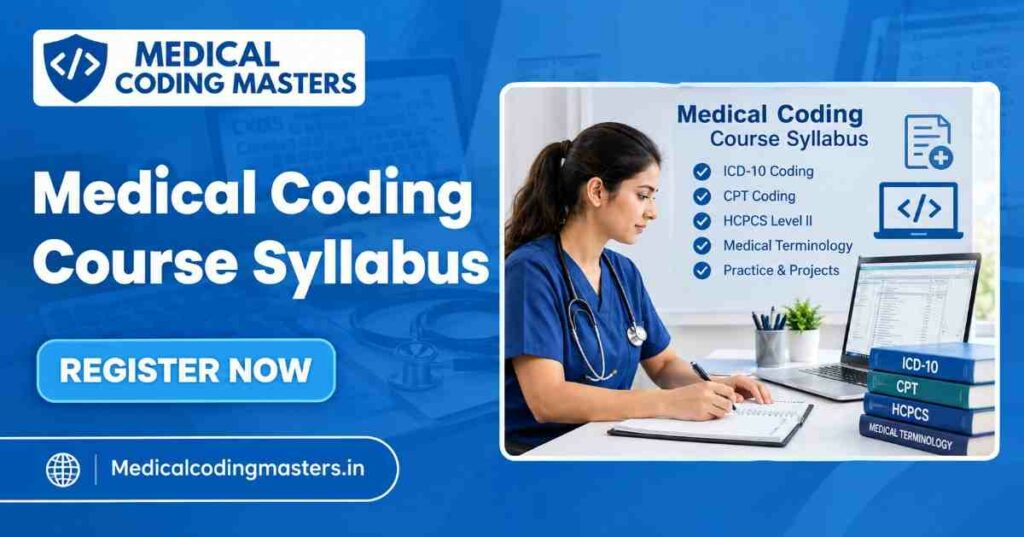
Medical Coding Course Syllabus
Medical Coding Course Syllabus in Hyderabad
The 28-Module Syllabus at a Glance
A good medical coding syllabus follows the order a working coder learns the job. Our medical coding training program Hyderabad spans three months and includes 28 modules organized into five learning stages. Each module concludes with a quiz, followed by CPC, CCS, and CCA practice tests to help you prepare for certification exams.
This guide does not repeat every topic list. For the complete module-by-module breakdown, see the full syllabus on the Medical Coding Course in Hyderabad page. Here you will see how the stages fit together and what to focus on in each. If you want the bigger picture first, read our medical coding career path guide.
Stage | Modules | Focus |
1 · Foundations | 1–4 | Healthcare systems, medical terminology, anatomy, ethics and compliance |
2 · Diagnosis coding | 5–12 | ICD-10-CM, from manual structure to every chapter group |
3 · Procedure coding | 13–18 | CPT, E/M guidelines, modifiers and audits |
4 · Specialty coding | 19–26 | Seven specialty modules plus HCPCS Level II |
5 · Career readiness | 27–28 | Soft skills and resume writing, both complimentary |
Stage 1 (Modules 1–4): Foundations Before Any Code
The first four modules cover healthcare systems, medical terminology, human anatomy and physiology, and medical ethics, confidentiality and compliance. No coding starts until these are done.
That order is deliberate. Non-medical learners are not left behind, and everyone gains the vocabulary needed to read a physician note without guessing.
How to get the most from this stage:
- Keep a personal list of abbreviations and root words and revise it weekly
- Link each body system to the ICD-10-CM chapter you will meet later
- Treat HIPAA and confidentiality as working rules, and read the HHS summary of the HIPAA Privacy Rule to see the official wording.
Like what you see so far?
Attend a free live demo class with our trainers before you decide.
Stage 2 (Modules 5–12): ICD-10-CM Diagnosis Coding
Eight modules are given to diagnose coding. Module 5 introduces the manual and the official guidelines. Modules 6 to 11 then move through the chapters by body system and condition group, and Module 12 closes with Z, S, V and E codes and a full mixed case set.
What to focus on:
- Read the conventions and guidelines before you start looking up codes, and get the official ICD-10-CM files from the CDC National Center for Health Statistics.
- Look up the medical term using the Alphabetic Index, and verify the code selection in the Tabular List before finalizing it.
- Pay attention to sequencing, laterality and specificity, where most beginner slips happen
Like what you see so far?
Join a complimentary live demonstration session to explore the training and interact with our trainers before enrolling.
Stage 3 (Modules 13–18): CPT, E/M and Modifiers
Procedure coding begins with how CPT is organised and how it differs from HCPCS (Module 13). Modules 14 to 16 introduce the integumentary system and the other CPT sections. Modules 17 and 18 are devoted to Evaluation and Management guidelines, modifiers and audits. CPT is maintained by the American Medical Association, and its CPT code set basics page is a good official overview.
E/M and modifiers get two full modules because they are among the most coded and most audited areas, and a favourite with interview panels. Once you reach this stage, start practising with our medical coding interview questions.
What to focus on:
- Decide the E/M level by medical decision making or time, and justify it from the note
- Learn when modifiers such as 25 and 59 apply, and when they do not
- Audit your own coded charts, since denials often start with small coding errors
Stage 4 (Modules 19–26): Specialty Coding and HCPCS Level II
Modules 19 to 25 give each specialty its own module: surgery, musculoskeletal, digestive, urology and reproductive, pulmonology and cardiovascular, radiology and pathology, and anesthesia. In Module 26, you will study HCPCS Level II coding for medical supplies and drugs, along with essential coding resources and reference materials used in everyday practice. HCPCS Level II is maintained by CMS, and its official HCPCS page lists updates and coding decisions.
What to focus on:
- Read operative reports slowly and list each procedure before choosing codes
- Check bundling and NCCI edits before you finalise a code set
- Use an encoder to speed up lookups, but verify against the guidelines in the code book
Coding is one half of the revenue cycle. If the claims and payment side interests you too, compare our medical billing training in Hyderabad and read about the top software tools used for medical billing.
Need the complete module list?
Connect with our course advisor to learn about the curriculum, upcoming batches, course fees, and certification preparation.
Need the complete module list?
Connect with our course advisor to learn about the curriculum, upcoming batches, course fees, and certification preparation.
Stage 5 (Modules 27–28) and Exam Practice: Getting Job-Ready
The last two modules, soft skills and resume writing, are complimentary. They turn the technical syllabus into interview-ready skills: clear communication, a resume built around the coding you have practised, and confidence in a live round.
Alongside them, the quiz after every module and the CPC, CCS and CCA mock tests show exactly where you stand. Treat each mock paper as a diagnostic: note the sections that slow you down and revise those first.
The course completion certificate is separate from the CPC, CCS or CCA credential, which AAPC or AHIMA issues after you pass their exam. Check current exam details on AAPC and AHIMA before you book.
How to Pace the Syllabus Over Three Months
Classroom batches run near JNTU Metro Station, Hyderabad, and the next batch starts on 1 November 2026. Your batch trainer sets the exact schedule, but this rough pacing helps you plan your own revision:
- Month 1: foundations, then begin ICD-10-CM
- Month 2: finish ICD-10-CM, then CPT, E/M and modifiers
- Month 3: specialty coding, HCPCS, soft skills, resume and mock tests
Whatever the pace, revise each module through its quiz before moving on. Stages 2 to 4 build on each other, so gaps carry forward.
Quick Checks When Comparing Any Medical Coding Syllabus
- Is E/M taught in depth, or in a single session?
- Does each specialty have its own module, or is it covered in passing?
- Are there quizzes after each module and full-length mock exams?
- Do you code real-style charts, not just slides?
- Can you sit in on a live class before you pay?
If you want to see our answers first-hand, meet our trainers or book a free demo.
Want to see how we teach?
Sit in on a real class and ask your questions.
What to Do After You Finish the Syllabus
Ready to start learning?
The next batch starts on 1 November 2026.
STILL WONDERING?
Frequently Asked Questions (FAQs)
Do I need a medical background to follow the syllabus?
No. The first four modules teach healthcare systems, terminology, anatomy and ethics from scratch, so freshers and non-medical graduates can follow.
Does the course guarantee a job?
No. We offer career counselling, resume support, interview preparation and recruitment updates, but the hiring decision belongs to the employer.
Can I study the syllabus online if I live outside Hyderabad?
Yes. Live online batches follow the same 28 modules with daily recordings, and the self-paced course gives you 90+ recorded HD classes with lifetime access.
Can I attend a demo class before I enrol?
Yes. Book a free demo class and sit in on a real session with the trainers and the batch you would join.
What is the course fee?
The fee depends on the mode you choose. Call or WhatsApp +91 81868 44555, or use our contact page, for the current fee. Certification exam fees are paid separately to AAPC or AHIMA.
How can I get the complete syllabus?
Request it from a counsellor on WhatsApp or through a free demo booking, or view the module list on our course page.
Which certification should I attempt first?
For most freshers, the AAPC CPC is a common first credential because it covers outpatient and physician coding. If hospital coding interests you more, compare the AHIMA options. Decide your work setting first.