Blog › Careers
Career guide · Medical coding
Medical Coding Career Path: From Beginner to Leadership Role
Medical coding is one of the fastest-growing career options in the healthcare industry for individuals who want to work in a non-clinical role.
✍️ Medical Coding Masters editorial team
🧠 JUMP TO WHAT YOU NEED
Questions this guide answers
🧑🎓 Who can become a medical coder?
→
🧩 The path from beginner to leader
→
📈 How salary grows
→
🚀 How to start a coding career
→
ON THIS PAGE
Skills required Career path Certifications Salary growth Future scope How to start Common challenges FAQsPrefer a guided path?
Our trainers help you build the skills that lead to a better first offer. Sit in on a class for free.
Book a free demoMedical Coding Carrer Path
Start Your Journey Toward a Rewarding Career in Healthcare
Medical coding is one of the fastest-growing career options in the healthcare industry for individuals who want to work in a non-clinical role.
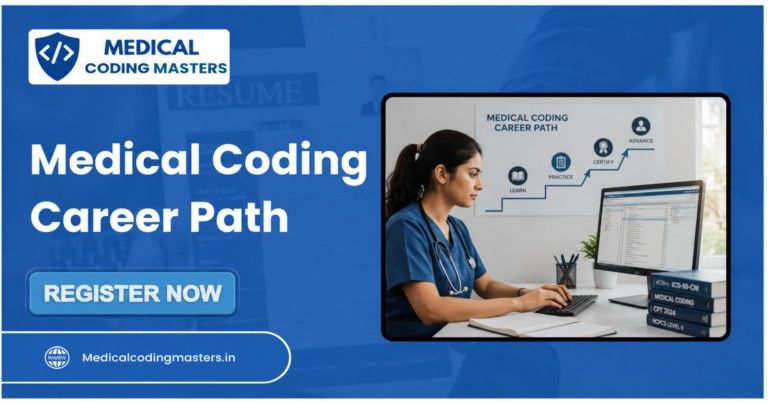
It offers a structured career path with opportunities to grow from an entry-level medical coder to senior positions such as Quality Analyst, Medical Coding Auditor, Team Lead, and Coding Manager.
With the increasing adoption of digital healthcare systems and standardized medical documentation, skilled medical coders continue to play an important role in supporting hospitals, healthcare providers, insurance companies, and medical billing organizations.
Whether you’re a student, a recent graduate, or planning a career change, understanding the medical coding career path can help you make informed decisions about your future.
This guide explains how to start a career in medical coding, the skills and qualifications required, career progression, certifications, salary growth, and the opportunities available in Hyderabad and across the healthcare industry.
Quick Overview:
| Career Level | Typical Role |
| Beginner | Medical Coding Trainee |
| Entry Level | Junior Medical Coder |
| Mid-Level | Certified Medical Coder |
| Experienced | Senior Medical Coder |
| Advanced | Quality Analyst / Auditor |
| Leadership | Team Lead / Coding Manager |
What You’ll Learn in This Guide
- What a medical coding career involves
- Skills and qualifications required
- Step-by-step career progression
- Medical coding certifications
- Career opportunities in Hyderabad
- Future scope of medical coding
- Tips to build a successful career
What Is a Medical Coding Career?
A medical coding career involves converting patient diagnoses, treatments, and medical procedures into standardized codes used by healthcare organizations worldwide.
These codes help hospitals, clinics, insurance companies, and other healthcare providers maintain accurate medical records, process insurance claims, and ensure compliance with healthcare regulations.
Medical coders work behind the scenes, but their role is essential to the healthcare system. They carefully review clinical documentation provided by doctors and assign the appropriate codes using internationally recognized coding systems such as ICD-10-CM, CPT, and HCPCS.
Accurate coding helps reduce billing errors, supports proper reimbursement, and contributes to efficient healthcare management.
Unlike clinical professionals who provide direct patient care, medical coders focus on healthcare documentation and coding accuracy.
This makes medical coding an excellent career choice for individuals who are interested in healthcare, have strong attention to detail, and enjoy working with medical records and technology.
Where Do Medical Coders Work?
Medical coding professionals can find employment in a variety of healthcare settings, including:
- Hospitals and multi-specialty healthcare centers
- Medical billing companies
- Health insurance organizations
- Healthcare BPO and KPO companies
- Diagnostic laboratories
- Pharmaceutical and life sciences companies
- Healthcare IT and health-tech organizations
As the healthcare industry continues to expand, the demand for trained medical coders is increasing across both domestic and international healthcare organizations, creating diverse career opportunities for qualified professionals.
Quick Tip: Building a strong foundation in medical terminology, anatomy, and coding guidelines can make it easier to start a successful career in medical coding and prepare for advanced roles in the future.
Like what you see so far?
Attend a free live demo class with our trainers before you decide.
Why Choose Medical Coding as a Career?
Medical coding is an important profession within the healthcare industry, offering individuals the opportunity to build a stable and rewarding non-clinical career.
As hospitals, clinics, and insurance companies continue to adopt digital healthcare systems, the need for skilled medical coding professionals continues to grow.
This creates opportunities for individuals who want a stable and rewarding career in a non-clinical healthcare role.
One of the biggest advantages of a medical coding career is the clear path for professional growth. With the right training, practical experience, and continuous learning, professionals can progress from entry-level coding positions to specialized and leadership roles.
The profession also offers opportunities to work across different healthcare sectors, making it a flexible career choice for both fresh graduates and experienced professionals.
Benefits of Choosing Medical Coding as a Career:
✔ Growing demand in the healthcare industry
✔ Opportunities for fresh graduates and career changers
✔ Career growth through experience and certifications
✔ Exposure to hospitals, insurance companies, healthcare BPOs, and health-tech organizations
✔ Continuous learning and specialization opportunities
✔ Profession that supports the evolving digital healthcare ecosystem
Why It Matters:
Medical coding involves much more than converting medical information into standardized codes. It is a profession that contributes to accurate healthcare documentation, efficient insurance claim processing, and better healthcare management.
As the healthcare industry continues to evolve, skilled medical coders remain an important part of delivering quality healthcare services.
Who Can Become a Medical Coder?
Medical coding is a career option for individuals who have an interest in healthcare, medical terminology, and analytical work.
While candidates from life sciences and healthcare backgrounds often have an advantage, many employers also value practical coding knowledge, attention to detail, and a willingness to learn.
If you’re planning to start a career in medical coding, building a strong understanding of anatomy, physiology, medical terminology, and coding guidelines can help you prepare for entry-level opportunities in the healthcare industry.
Educational Backgrounds That Can Pursue Medical Coding:
Medical coding is commonly chosen by candidates from the following backgrounds:
- Life Sciences (B.Sc.)
- Pharmacy (B.Pharm, D.Pharm)
- Nursing (B.Sc. Nursing, GNM, ANM)
- Physiotherapy (BPT)
- Biotechnology
- Microbiology
- Biochemistry
- Allied Health Sciences
- Dentistry (BDS)
- Medicine (MBBS)
Candidates from other educational backgrounds may also explore medical coding after developing the required knowledge and skills. Eligibility requirements can vary depending on the employer, job role, and training program.
Qualities That Can Help You Succeed:
Along with educational qualifications, employers often look for candidates who demonstrate:
- Attention to detail
- Good analytical and logical thinking
- Basic computer proficiency
- Willingness to learn medical concepts
- Strong reading and comprehension skills
- Commitment to accuracy and quality
These qualities can help you understand medical documentation, apply coding guidelines correctly, and perform your responsibilities with confidence.
Why Choosing the Right Training Matters:
A structured training program can help bridge the gap between academic knowledge and industry expectations.
Learning coding systems such as ICD-10-CM, CPT, and HCPCS, along with practical exercises and case-based learning, can help aspiring professionals develop job-ready skills before applying for entry-level roles.
Planning to start your journey in medical coding?
Explore our Medical Coding Course in Hyderabad to learn how structured training, practical learning, and expert guidance can help you prepare for a career in the healthcare industry.
Skills Required for a Successful Medical Coding Career
Building a successful career in medical coding requires more than learning medical codes.
Employers look for professionals who can accurately interpret medical records, understand healthcare documentation, and apply coding guidelines with precision.
Building a strong foundation in technical knowledge and workplace skills can help you handle medical coding responsibilities effectively while supporting your long-term career growth.
Whether you’re a beginner or preparing for your first medical coding role, focusing on these essential skills can help you build a strong foundation.
Technical Skills:
Medical coders work with healthcare documentation every day, so developing technical knowledge is essential. To perform medical coding accurately, professionals should develop the following technical skills:
- Medical Terminology
- Human Anatomy and Physiology
- ICD-10-CM Coding
- CPT Coding
- HCPCS Coding
- Healthcare Documentation
- Electronic Health Records (EHR)
- Basic Computer Skills
A strong understanding of these areas helps medical coders assign accurate codes and maintain proper clinical documentation.
Professional Skills:
In addition to technical knowledge, strong professional skills help medical coders maintain accuracy, work efficiently, and meet industry standards.
These include:
- Attention to Detail
- Analytical Thinking
- Problem-Solving Skills
- Time Management
- Communication Skills
- Willingness to Learn
- Accuracy and Quality Focus
These skills help medical coders review patient records carefully, identify documentation gaps, and maintain coding quality while meeting organizational standards.
Why These Skills Matter
Medical coding is a detail-oriented profession where accuracy is essential. Accurate medical coding is essential, as even minor mistakes can influence the quality of healthcare documentation and the efficiency of the claims process.
Developing the right combination of technical knowledge and professional skills can improve your confidence, support continuous learning, and prepare you for career growth in the healthcare industry.
Career Tip:
If you’re new to medical coding, start by building a strong understanding of medical terminology and anatomy before moving on to coding systems such as ICD-10-CM, CPT, and HCPCS.
A structured training program with practical exercises can help you apply these concepts more effectively.
Need help choosing a path?
Talk to a counsellor about batches, fees and certification.
Medical Coding Career Path: From Beginner to Leadership Roles
Medical coding provides a clear career progression, enabling professionals to expand their knowledge, strengthen their skills, and take on greater responsibilities as they gain experience.
As you gain practical experience, improve your coding accuracy, and earn industry-recognized certifications, you can move into specialized and leadership positions within the healthcare industry.
While the exact career journey may vary based on the employer, qualifications, certifications, and performance, the following roadmap represents a common progression followed by many medical coding professionals.
Step 1: Medical Coding Trainee
Every medical coding career begins with learning the fundamentals. As a trainee, you’ll become familiar with medical terminology, anatomy, physiology, healthcare documentation, and standard coding systems such as ICD-10-CM, CPT, and HCPCS.
This stage focuses on developing a strong foundation and understanding industry coding guidelines.
Key Responsibilities:
- Learn medical coding concepts and standards
- Practice assigning diagnosis and procedure codes
- Understand healthcare documentation
- Build accuracy through training and case studies
Step 2: Junior Medical Coder
After completing your training and demonstrating basic coding skills, you may begin working as a Junior Medical Coder.
At this stage, you’ll review patient records, assign appropriate medical codes, and work under the guidance of experienced professionals while continuing to improve your coding knowledge.
Key Responsibilities:
- Review patient documentation
- Assign standardized medical codes
- Follow coding guidelines and compliance standards
- Maintain coding accuracy and productivity
Step 3: Certified Medical Coder
As you gain experience and earn relevant certifications, you can progress to the role of a Certified Medical Coder.
Professionals at this level are expected to code more independently, handle a wider variety of medical specialties, and maintain a high level of accuracy in their work.
Key Responsibilities:
- Handle coding independently
- Work with multiple medical specialties
- Improve coding quality and efficiency
- Stay updated with coding guideline changes
Step 4: Senior Medical Coder
Senior Medical Coders manage more complex medical cases and often support junior team members.
Their experience allows them to review challenging documentation, resolve coding issues, and contribute to maintaining high coding standards within the organization.
Key Responsibilities:
- Review complex medical records
- Mentor junior coders
- Resolve coding-related queries
- Support quality improvement initiatives
Step 5: Quality Analyst or Medical Coding Auditor
With advanced experience, professionals may move into quality assurance or auditing roles.
These positions focus on reviewing coding accuracy, identifying documentation issues, ensuring compliance with coding standards, and providing feedback to improve overall coding quality.
Key Responsibilities:
- Conduct coding quality reviews
- Perform coding audits
- Ensure compliance with coding guidelines
- Recommend improvements to coding practices
Step 6: Team Lead or Coding Manager
Leadership roles involve managing coding teams, monitoring performance, coordinating workflows, and supporting operational goals.
Team Leads and Coding Managers also help train team members, maintain quality standards, and ensure projects are completed efficiently.
Key Responsibilities:
- Lead and mentor coding teams
- Monitor productivity and quality
- Coordinate daily operations
- Support team development and performance
Career Progression at a Glance:
Career Stage | Primary Focus | Skills Developed |
Medical Coding Trainee | Learning the fundamentals | Medical terminology, anatomy, coding basics |
Junior Medical Coder | Applying coding skills | Accuracy, documentation review, coding guidelines |
Certified Medical Coder | Independent coding | Productivity, specialization, compliance |
Senior Medical Coder | Managing complex cases | Problem-solving, mentoring, advanced coding |
Quality Analyst / Auditor | Reviewing coding quality | Auditing, compliance, quality assurance |
Team Lead / Coding Manager | Leading teams | Leadership, operations, team management |
Note:
Career progression depends on several factors, including practical experience, coding accuracy, continuous learning, certifications, and organizational requirements. Career paths may vary across employers and healthcare organizations.
Career Tip:
A successful medical coding career isn’t defined by experience alone.
Professionals who consistently update their knowledge, adapt to changes in coding standards, and develop strong analytical skills are often better positioned for long-term growth and leadership opportunities.
Medical Coding Certifications That Can Boost Your Career
Professional certifications play an important role in the medical coding industry. They validate your coding knowledge, demonstrate your commitment to professional development, and can strengthen your profile when applying for medical coding roles.
While certifications are not mandatory for every position, many employers value candidates who have completed recognized certification programs or are actively preparing for certification exams.
Choosing the right certification depends on your career goals, experience, and the type of healthcare organization you want to work with.
As you gain experience, certifications can also help you specialize in specific areas of medical coding and support long-term career growth.
Popular Medical Coding Certifications:
Certified Professional Coder (CPC):
The Certified Professional Coder (CPC) credential is one of the most recognized certifications for professionals interested in physician and outpatient medical coding.
It focuses on coding guidelines, medical terminology, anatomy, and healthcare documentation, making it a popular choice for individuals starting their medical coding careers.
Certified Coding Specialist (CCS):
The Certified Coding Specialist (CCS) certification is designed for professionals working with hospital-based coding. It emphasizes accurate coding of inpatient and outpatient medical records and demonstrates advanced coding knowledge.
Certified Risk Adjustment Coder (CRC)
The Certified Risk Adjustment Coder (CRC) certification focuses on risk adjustment coding used in value-based healthcare models. It is suitable for professionals interested in risk adjustment documentation and coding practices.
Certified Outpatient Coder (COC)
The Certified Outpatient Coder (COC) credential focuses on outpatient facility coding. It helps professionals develop expertise in coding services provided in hospital outpatient departments and ambulatory care settings.
Benefits of Earning a Certification:
Obtaining a professional certification can offer several advantages throughout your career, including:
- Demonstrates your coding knowledge and technical skills.
- Enhances your professional credibility.
- Supports career growth and specialization.
- Improves confidence in applying coding guidelines.
- Helps you stay updated with industry standards and best practices.
Choosing the Right Certification:
Before selecting a certification, consider factors such as your career goals, current qualifications, preferred work environment, and the certification requirements. Before selecting a certification, take time to understand its purpose, eligibility requirements, and how it supports your long-term career goals.
Tip:
A structured medical coding training program can help you understand coding concepts, prepare for certification exams, and develop practical skills before entering the workforce.
Medical Coding Salary Growth
Medical coding offers a career with opportunities for professional and financial growth as individuals gain experience, improve their coding accuracy, and develop specialized knowledge.
While salary levels vary depending on several factors, professionals who continue learning and enhance their skills often become eligible for more advanced roles and responsibilities.
As medical coders progress in their careers, they may take on complex coding assignments, specialize in particular medical disciplines, or move into quality assurance, auditing, or leadership positions. These advancements can contribute to long-term career development.
Factors That Influence Salary Growth:
Several factors can affect a medical coding professional’s career progression and earning potential, including:
- Educational qualifications
- Practical coding knowledge
- Professional certifications
- Years of industry experience
- Coding accuracy and productivity
- Area of specialization
- Type of healthcare organization
- Location of employment
Developing strong technical skills and maintaining high coding standards can help professionals prepare for advanced career opportunities over time.
Career Progression and Growth:
As professionals gain experience and expand their expertise, they may progress through different stages of their careers.
Experience Level | Typical Career Progression |
Beginner | Medical Coding Trainee |
Entry Level | Junior Medical Coder |
Mid-Level | Medical Coder / Certified Medical Coder |
Experienced | Senior Medical Coder |
Advanced | Quality Analyst / Medical Coding Auditor |
Leadership | Team Lead / Coding Manager |
Career progression depends on individual performance, continuous learning, organizational requirements, and the ability to adapt to evolving coding standards.
How to Improve Your Career Growth:
Professionals who focus on continuous improvement are often better prepared for long-term career development. You can strengthen your career by:
- Keeping up with the latest coding guidelines
- Improving coding accuracy and productivity
- Gaining practical coding experience
- Building expertise in different medical specialties
- Pursuing relevant professional certifications
- Developing communication and analytical skills
Continuous learning not only improves technical knowledge but also prepares professionals for specialized and leadership roles within the healthcare industry.
Key Takeaway:
Medical coding provides a structured career path where growth is supported by experience, skill development, and continuous learning. While salary varies based on individual and organizational factors, investing in professional development can help create opportunities for career advancement over time.
Ready to build your career in medical coding?
A strong foundation in coding concepts, practical training, and industry best practices can help you prepare for long-term growth. Explore our Medical Coding Course in Hyderabad to begin your journey.
Want to see how we teach?
Sit in on a real class and ask your questions.
Future Scope of Medical Coding
As healthcare systems continue to advance, medical coding remains an essential part of ensuring accurate clinical documentation and supporting efficient healthcare administrative processes.
As hospitals and healthcare organizations adopt electronic health records (EHRs) and digital healthcare systems, the need for accurate and standardized medical coding remains essential.
Advancements in healthcare technology are changing the way medical coding is performed. While artificial intelligence (AI) and automation can assist with repetitive coding tasks, trained medical coding professionals are still needed to review clinical documentation, apply coding guidelines correctly, and ensure coding accuracy.
Human expertise continues to be important, especially when handling complex medical cases and maintaining compliance with industry standards.
Why Medical Coding Continues to Be Relevant:
Several factors contribute to the continued demand for medical coding professionals:
- Growth of the healthcare industry
- Increasing use of electronic health records (EHR)
- Expanding health insurance services
- Standardized medical documentation requirements
- Ongoing updates to medical coding guidelines
- Rising demand for healthcare data accuracy
These developments create opportunities for professionals who continuously improve their knowledge and adapt to changes in the healthcare industry.
How to Stay Future-Ready:
Building a long-term career in medical coding requires continuous learning and skill development.Individuals can enhance their long-term career growth by focusing on the following areas:Staying updated with coding guidelines and industry changes
- Learning new healthcare technologies
- Improving coding accuracy and productivity
- Pursuing relevant certifications
- Developing expertise in specialized coding areas
- Enhancing communication and analytical skills
Continuous learning helps professionals adapt to changing industry requirements and prepares them for advanced career opportunities.
Medical Coding and AI:
Artificial intelligence is becoming a valuable support tool in healthcare, helping improve efficiency in documentation and coding workflows. However, AI is designed to assist rather than replace qualified medical coding professionals.
Human coders remain responsible for interpreting complex clinical records, applying coding standards accurately, resolving documentation issues, and ensuring compliance with healthcare regulations.
Professionals who combine coding expertise with an understanding of emerging technologies will be well-positioned to adapt as the healthcare industry evolves.
Key Takeaway:
Medical coding continues to offer long-term career opportunities for individuals who are committed to continuous learning and professional development. As healthcare systems become more digital, skilled medical coders who maintain strong coding knowledge and adapt to industry changes will continue to play an important role in healthcare documentation and revenue cycle management.
Looking to build a future in medical coding?
Developing strong coding fundamentals, practical experience, and industry-relevant skills can help you prepare for long-term career growth.
Learn more about our Medical Coding Course in Hyderabad and take the next step toward your career goals.
How to Start a Medical Coding Career
Starting a career in medical coding requires the right combination of knowledge, practical training, and continuous learning. Whether you’re a recent graduate or planning a career transition, following a structured approach can help you build the skills needed to enter the healthcare industry with confidence.
While every individual’s journey may be different, these steps can help you prepare for a career in medical coding.
Step 1: Build a Strong Foundation in Medical Coding
Begin by learning the fundamentals of medical coding, including medical terminology, anatomy, physiology, and the purpose of standardized coding systems. A strong foundation makes it easier to understand clinical documentation and coding guidelines.
Step 2: Learn Standard Coding Systems
Medical coders rely on standardized coding systems to accurately document diagnoses, medical procedures, and healthcare services, such as:
- ICD-10-CM
- CPT
- HCPCS
Understanding how these coding systems are used in healthcare documentation is an important step in developing coding skills.
Step 3: Gain Practical Training
Hands-on training enables learners to apply theoretical knowledge in practical medical coding scenarios. Working on coding exercises, case studies, and sample medical records can improve your confidence and strengthen your understanding of coding guidelines.
Step 4: Develop Essential Skills
In addition to technical knowledge, focus on developing professional skills such as:
- Attention to detail
- Analytical thinking
- Communication skills
- Time management
- Computer proficiency
These skills support accuracy and efficiency in day-to-day coding responsibilities.
Step 5: Prepare for Professional Certifications
Once you have developed a strong understanding of medical coding concepts, you can prepare for industry-recognized certification exams that align with your career goals. Earning a professional certification reflects your knowledge and contributes to your continued career growth.
Step 6: Apply for Entry-Level Opportunities
After completing your training and building practical knowledge, you can begin applying for entry-level medical coding roles. Continue improving your skills through workplace experience, ongoing learning, and staying updated with industry guidelines.
Your Career Roadmap:
- Learn Medical Coding
- Understand ICD-10-CM, CPT & HCPCS
- Gain Practical Training
- Develop Coding Skills
- Prepare for Certifications
Apply for Entry-Level Roles
Continue Learning & Grow Professionally
Key Takeaway:
Building a successful medical coding career takes dedication, continuous learning, and practical experience. By developing strong coding fundamentals and staying updated with industry standards, you can prepare yourself for long-term growth in the healthcare industry.
Ready to begin your medical coding journey?
Explore our Medical Coding Course in Hyderabad to learn how our structured curriculum, practical training, and expert guidance can help you build the skills needed for a successful career in medical coding.
Why Choose Medical Coding Masters for Your Medical Coding Journey?
Choosing the right training institute is an important step when starting a career in medical coding. A structured learning environment, experienced trainers, practical exposure, and career guidance can help you build the knowledge and confidence needed to enter the healthcare industry.
At Medical Coding Masters, the focus is on helping students understand medical coding concepts through industry-oriented training and practical learning.
The curriculum is designed to introduce learners to medical terminology, anatomy, physiology, ICD-10-CM, CPT, HCPCS, and healthcare documentation, preparing them for real-world medical coding practices.
What Makes Medical Coding Masters Different?
- Industry-oriented curriculum
- Experienced trainers
- Practical coding exercises and case-based learning
- Focus on medical terminology and coding standards
- Guidance for certification preparation
- Learning environment designed to build job-ready skills
Learning That Supports Career Growth:
Medical coding requires continuous learning, accuracy, and attention to detail. A structured training program can help learners strengthen these skills while gaining confidence in applying coding guidelines to healthcare documentation.
Whether you’re starting your career or planning to upskill, learning from experienced professionals and practicing with real-world coding scenarios can support your long-term professional development.
Begin Your Journey in Medical Coding Today:
If you’re planning to build a career in the healthcare industry, now is the right time to develop the skills required for medical coding.
With structured learning, practical training, and continuous guidance, you can prepare yourself for entry-level opportunities and future career growth.
Explore our Medical Coding Course in Hyderabad to learn more about the curriculum, training approach, and career support available at Medical Coding Masters.
Ready to start learning?
The next batch starts on 1 November 2026.
Common Challenges in a Medical Coding Career
Like any profession, medical coding comes with responsibilities that require continuous learning and attention to detail. Being aware of these challenges allows aspiring medical coders to build the knowledge, skills, and confidence needed for long-term career growth.
Some common challenges include:
- Keeping up with updated coding guidelines
- Understanding complex medical documentation
- Maintaining coding accuracy
- Meeting productivity expectations
- Learning new healthcare technologies
- Continuous skill development
Despite these challenges, regular practice, structured training, and staying updated with industry standards can help professionals build confidence and perform effectively in medical coding roles.
STILL WONDERING?
Frequently Asked Questions (FAQs)
What is a medical coding career?
A medical coding career involves reviewing patient medical records and converting diagnoses, procedures, and treatments into standardized medical codes. These codes are used for healthcare documentation, insurance claim processing, billing, and maintaining accurate patient records across hospitals and healthcare organizations.
Is medical coding a good career?
Medical coding can be a suitable career choice for individuals who are interested in healthcare, enjoy analytical work, and have strong attention to detail. As healthcare documentation continues to evolve, trained medical coding professionals remain an important part of healthcare operations.
Who is eligible for a medical coding career?
Medical coding is commonly pursued by graduates from Life Sciences, Pharmacy, Nursing, Physiotherapy, Biotechnology, Microbiology, Biochemistry, Allied Health Sciences, Dentistry, and Medicine. Eligibility requirements may vary depending on the employer and the specific job role.
What skills are required for medical coding?
Medical coders benefit from a strong understanding of medical terminology, anatomy, physiology, ICD-10-CM, CPT, and HCPCS coding systems. Professional skills such as attention to detail, analytical thinking, communication, and time management are also important.
What certifications are available in medical coding?
Some widely recognized certifications include Certified Professional Coder (CPC), Certified Coding Specialist (CCS), Certified Risk Adjustment Coder (CRC), and Certified Outpatient Coder (COC). The right certification depends on your career goals and the area of medical coding you wish to specialize in.
What is the career path in medical coding?
A typical career path may begin as a Medical Coding Trainee, followed by Junior Medical Coder, Certified Medical Coder, Senior Medical Coder, Quality Analyst, Medical Coding Auditor, Team Lead, and Coding Manager. Career progression depends on experience, skills, certifications, and organizational requirements.
Does medical coding have a future?
Medical coding continues to play an important role in healthcare documentation and revenue cycle management. As healthcare organizations increasingly adopt digital systems, trained professionals who stay updated with coding standards and industry changes can continue to find career opportunities.
Can AI replace medical coders?
Artificial intelligence can assist with certain coding-related tasks, but it does not replace the need for skilled professionals. Medical coders are responsible for interpreting clinical documentation, applying coding guidelines accurately, and ensuring compliance with healthcare standards, especially in complex cases.
How can I start a career in medical coding?
The first step is to learn medical terminology, anatomy, and coding systems such as ICD-10-CM, CPT, and HCPCS. Practical training, continuous learning, and preparation for relevant certifications can help you build the knowledge needed for entry-level medical coding roles.
How can Medical Coding Masters help me?
Medical Coding Masters offers structured training designed to help learners understand medical coding concepts, coding systems, healthcare documentation, and industry practices. The program focuses on building practical knowledge that can support individuals preparing for a career in medical coding.