Blog › Careers
Jobs guide · Hyderabad
CPC vs CCS: Which Medical Coding Certification to Choose in Hyderabad (2026)
CPC and CCS are two of the best-known medical coding credentials, but they are built for different kinds of work. This guide for learners on a medical coding course in Hyderabad compares scope, exam format, cost, renewal and career fit so you can pick the one that matches the job you want.
✍️ Medical Coding Masters editorial team
JUMP TO WHAT YOU NEED
Questions this guide answers
📋 CPC vs CCS at a glance
→
🧪 Which exam is harder
→
🧭 Which one to take first
→
🎓 How to prepare
→
ON THIS PAGE
What is CPC What is CCS Comparison table Exam difficulty Jobs and settings Cost and renewal Which to choose FAQsPrefer a guided path?
Our trainers help you build the skills that lead to a better first offer. Sit in on a class for free.
Book a free demoCPC vs CCS: Quick Overview
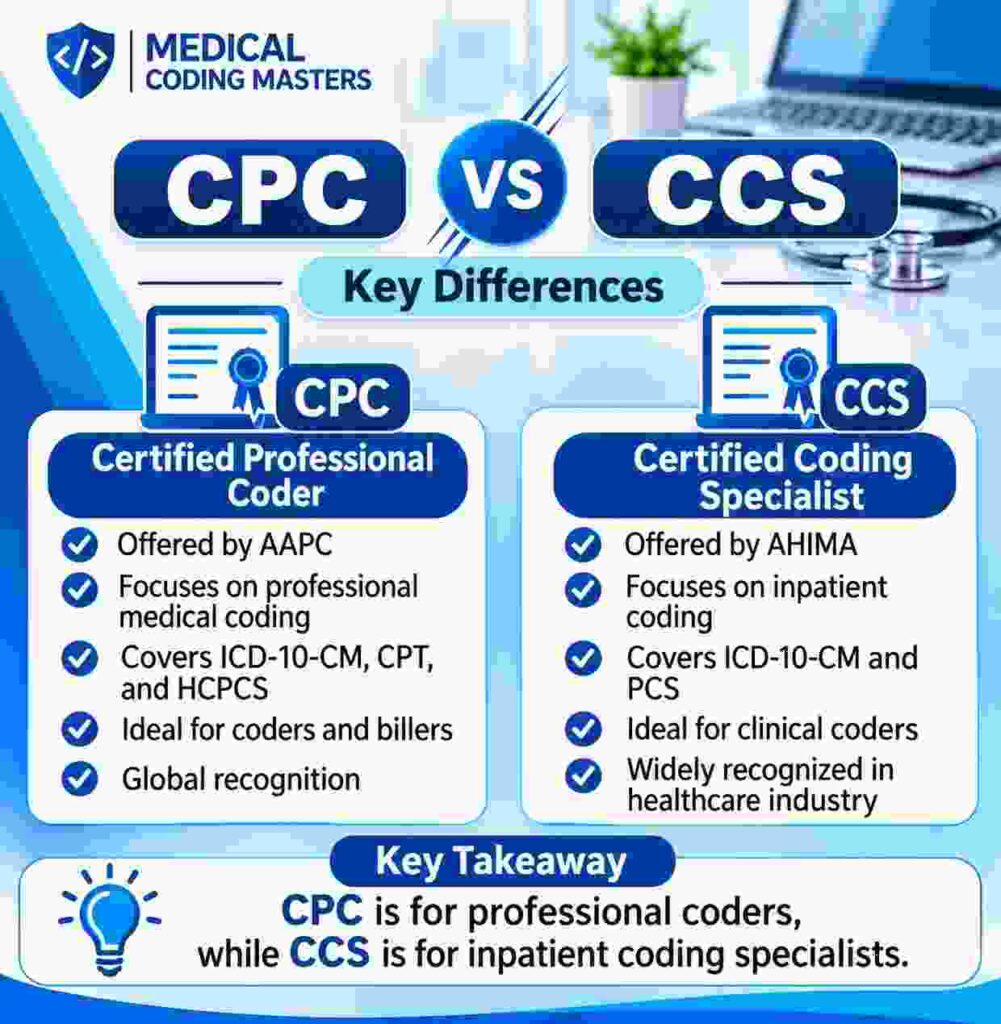
CPC and CCS are two of the best-known credentials in medical coding, and they are not interchangeable. Both are computer-based, both give you four hours, and both can strengthen your resume. What differs is the type of coding work each one is designed around.
In one line: CPC, issued by AAPC, is aimed at outpatient and physician-office coding. CCS, issued by AHIMA, is aimed at facility-based coding with a strong inpatient component.
Choosing early saves you exam fees and months of study in the wrong direction. If you are still getting comfortable with the basics, read our guide on what is medical coding first, then come back. Below you will find what each credential covers, a side-by-side table, how the exams feel, what they cost to earn and keep, and a simple way to decide.
CPC vs CCS
What Is the CPC Certification?
CPC stands for Certified Professional Coder, a credential awarded by AAPC (the American Academy of Professional Coders). It shows that you can code outpatient and physician services accurately and in line with payer and compliance rules. AAPC presents it as a strong starting point for a coding career, and its own overview is on the official AAPC CPC page.
A CPC works from clinic and physician-practice documentation, so the daily skill set looks like this:
- Diagnosis coding with ICD-10-CM across every body system.
- Procedure and service coding with CPT and HCPCS Level II for visits, procedures, supplies and drugs.
- Assigning appropriate Evaluation and Management (E/M) codes for office visits and other physician-provided healthcare services.
- Modifiers and medical necessity: linking diagnoses to services and using modifiers so a claim reflects what was actually done.
- Compliance awareness: Medicare, Medicaid and commercial payer rules, plus the basics of fraud and abuse.
You do not need work experience to sit the exam. Candidates without experience usually hold apprentice status until they meet AAPC’s experience requirements, so check the current rules before you register.
What Is the CCS Certification?
CCS stands for Certified Coding Specialist, a credential awarded by AHIMA (the American Health Information Management Association). AHIMA describes it as a credential for people skilled in classifying data from medical records, and as a natural next step for coders with inpatient and outpatient experience or for those who already hold the entry-level CCA. Details are on the official AHIMA CCS page.
Where CPC leans on physician-office notes, CCS leans on hospital and facility records, where a single stay can involve many diagnoses and procedures. The exam is organised around five areas:
- Coding knowledge and skills
- Coding documentation
- Provider queries
- Regulatory compliance
- Information technologies
On the code-set side, CCS adds ICD-10-PCS, the classification used for inpatient hospital procedures, alongside ICD-10-CM and CPT/HCPCS. If you have never worked with ICD-10-PCS, expect it to be the biggest new skill you need to build.
Not sure which credential fits you?
Attend a free live demo and ask our trainers how CPC and CCS preparation differs.
Not sure which credential fits you?
Attend a free live demo and ask our trainers how CPC and CCS preparation differs.
CPC vs CCS: Side-by-Side Comparison
Here is how the two credentials line up on the points candidates compare most often.
Factor | CPC | CCS |
Issued by | AAPC | AHIMA |
Setting focus | Outpatient and physician services | Hospital and facility coding, with strong inpatient content |
Code sets tested | ICD-10-CM, CPT, HCPCS Level II | ICD-10-CM, ICD-10-PCS, CPT/HCPCS |
Exam length | 100 multiple-choice questions | 107 questions (97 scored, 10 unscored pretest), including medical scenarios |
Time allowed | 4 hours, one sitting | 4 hours |
Passing score | 70% (70 of 100) | Scaled score of 300 |
Code books | Open code book (CPT, ICD-10-CM, HCPCS Level II) | Bring the editions on AHIMA’s required code book list |
How you test | Online with a live remote proctor, or at a testing centre | Computer-based at a Pearson VUE testing centre |
Prerequisites to sit | No experience requirement; apprentice status until experience is documented | Recommended, not required: coding coursework plus experience, or a related credential |
Exam rules can change, so confirm each row on the official AAPC and AHIMA pages before you book.
Which Exam Is Harder? How CPC and CCS Feel in Practice
Neither exam is easy, and which one is harder depends on your background. The two tests stress different skills.
- CPC rewards breadth and pace. One hundred questions in four hours works out to roughly 2.4 minutes each, across terminology, anatomy, ICD-10-CM, HCPCS and many CPT areas. Quick, accurate code-book navigation matters.
- CCS rewards depth and structure. There are fewer scored questions, but each leans on guideline application, ICD-10-PCS logic, documentation and provider-query judgement, plus medical scenarios where you code from a record excerpt.
AHIMA publishes first-time pass rates for the CCS: 64% in 2023, 75% in 2024 and 84% in 2025. AAPC reports results in a different way, so avoid comparing headline pass rates across the two bodies. Treat the figures as a reminder that structured practice pays off.
A practical test: if your study charts have been outpatient visits, CPC will feel familiar. If you have been working through discharge summaries and operative reports, CCS will.
Jobs and Work Settings Each Credential Fits
Broadly, CPC points to outpatient work and CCS to hospital work, but employers set their own requirements. Read the credential line in each job posting instead of assuming.
- CPC settings: physician practices, clinics, outpatient departments, same-day surgery centres and the outsourced revenue-cycle teams that code for them.
- CCS settings: hospital health-information and coding departments, inpatient coding teams and outsourced facility-coding processes.
In Hyderabad, much coding work supports overseas healthcare providers, so the credential an employer names usually follows the kind of US process it runs. For employer types and openings, see our guide to medical coding jobs in Hyderabad. For pay by experience and certification, read the medical coding salary guide. Pay depends on your experience, accuracy and employer more than on the credential name alone.
Studying in Hyderabad?
Visit our classroom near JNTU Metro or join live online. Ask a counsellor which batch fits.
Need help choosing a path?
Talk to a counsellor about batches, fees and certification.
What Each Credential Costs to Earn and Keep
Both credentials are priced in US dollars, so allow for exchange-rate changes. The figures below were listed on the official pages in November 2026. Fees change, so confirm before you pay.
- CPC exam: AAPC lists exam vouchers from $425 on its exam scheduling page. Holding the credential also requires an active AAPC membership, renewed annually.
- CPC upkeep: 36 continuing education units (CEUs) every two years.
- CCS exam: AHIMA lists $299 for members and $399 for non-members. The retake fee equals the exam fee, and a failed candidate waits at least 30 days before a new application is approved.
- CCS upkeep: CEUs plus a recertification fee over each two-year cycle; AHIMA explains the steps on its recertification page.
- Code books: budget for current editions. AHIMA publishes its required code book list for the CCS and can turn away candidates who arrive with the wrong ones, with exam fees forfeited.
Training fees are separate from exam fees. We cover them in medical coding course fees in Hyderabad.
CPC or CCS: Which Should You Take First?
Decide by the work you want in the next one to two years, not by which credential sounds more advanced.
- Starting from scratch and aiming at clinics or physician practices: CPC is the usual first step.
- Interested in hospital records, inpatient stays and ICD-10-PCS: CCS fits, ideally after you have built foundations or some experience, as AHIMA recommends.
- Already holding the CCA or working as a coder: CCS is the progression AHIMA itself describes.
- Still unsure: read ten job postings for the role you want and note which credential appears most. Let that settle it.
- Drawn to claims, payments and follow-up more than chart reading? Neither credential is the main fit. Compare our medical coding vs medical billing guide and our medical billing training.
Compare before you decide
Join a real class for free and put your questions to the trainer.
Can You Earn Both CPC and CCS?
Yes. Many coders hold both, and the order depends on where you start.
- CPC first, CCS later: build outpatient foundations, then add CCS if you move toward hospital coding.
- CCA first, CCS later: AHIMA’s entry-level CCA is a stepping stone toward CCS.
- One credential to begin with: each has its own renewal and CEU requirements, so add the second only when a role calls for it.
For the bigger picture of where each stage can lead, see our medical coding career path. Coders increasingly work alongside automation, so practise checking suggested codes against the guidelines; our note on generative AI in medical coding and billing explains where that is heading.
Want to see how we teach?
Sit in on a real class and ask your questions.
How to Prepare for the CPC or CCS Exam
Build the foundation once, then specialise for the exam you chose.
- Cover terminology and anatomy first. Both exams assume you can read a clinical note.
- Read the official guidelines, not only the code book. The ICD-10-CM Official Guidelines for Coding and Reporting set the sequencing and convention rules behind many answers. Check which code-set year your exam follows.
- Learn the layout of each code book. Mark them only in the ways the exam rules allow.
- Practise under time pressure early. Both exams give four hours, and pacing is a skill.
- Add the exam-specific layer. For CPC: E/M, surgery and modifiers. For CCS: ICD-10-PCS, sequencing, documentation and provider queries.
- Keep an error log. Group wrong answers by chapter or guideline and revise those first.
- Book the exam after steady mock scores, not after a single good paper.
Once you start applying, our medical coding interview questions help you rehearse the questions coding panels ask. If you would like a trainer to help with the choice, book a free demo.
Preparing for CPC and CCS in Our Medical Coding Course in Hyderabad
If you are weighing a medical coding course in Hyderabad, check that it prepares you for the credential you plan to take. Here is how ours maps to the CPC and CCS routes.
- Format: three months, with classroom batches near JNTU Metro Station, live online classes, or self-paced recorded classes, all on the same 28-module syllabus.
- Coverage: ICD-10-CM, CPT, E/M, HCPCS and specialty coding, with a quiz after every module.
- Exam practice: mock tests in CPC (AAPC) and CCS and CCA (AHIMA) styles.
- Certificates: you receive a Medical Coding Masters completion certificate, which is separate from the CPC or CCS credential. Those are issued by AAPC or AHIMA only after you pass their exam.
Key Takeaways
- CPC (AAPC) targets outpatient and physician-office coding; CCS (AHIMA) targets facility-based coding with strong inpatient content.
- CPC tests ICD-10-CM, CPT and HCPCS Level II; CCS adds ICD-10-PCS and scenario-style questions.
- Both allow four hours, but CPC rewards speed across many topics and CCS rewards guideline depth.
- Exam fees, code book rules and renewal terms change, so verify them on the AAPC and AHIMA pages.
- You can earn both over time; choose the first one by the setting you want to work in.
Ready to start learning?
The next batch starts on 1 November 2026.
Conclusion
The CPC vs CCS question comes down to setting. Choose CPC if outpatient and physician coding is your target, and choose CCS if hospital and inpatient coding is where you want to work. Neither credential guarantees a job, but the right one, paired with accurate chart coding, makes your profile easier for employers to read.
FAQ
What is the main difference between CPC and CCS?
CPC, from AAPC, centres on outpatient and physician-office coding. CCS, from AHIMA, centres on facility-based coding with strong inpatient content, including ICD-10-PCS.
Which is better for freshers, CPC or CCS?
Many freshers begin with CPC because AAPC lets you sit the exam without experience and outpatient coding is a common entry route. AHIMA recommends coursework plus experience before CCS. The better choice depends on the setting you want.
Is the CCS exam harder than the CPC exam?
Neither is easy. CPC is broad and time-pressured, while CCS goes deeper on guidelines, ICD-10-PCS and scenario questions. Your background decides which feels harder.
Are the CPC and CCS exams open book?
Both let you use code books, but the CCS requires the specific editions on AHIMA’s required list, and candidates without them can be refused entry.
Do I need work experience to take CPC or CCS?
CPC has no experience requirement to sit, though you hold apprentice status until you meet AAPC’s experience rules. For CCS, AHIMA recommends, but does not require, coding coursework plus experience or a related credential.
Can I hold both CPC and CCS?
Yes. Many coders add the second credential later as their role changes. Each one has its own renewal and CEU requirements.
Which credential do employers in India ask for?
It varies by process. Outpatient US-process roles often name CPC, while hospital and inpatient processes may name CCS. Read the job description before you decide.
Does a medical coding course in Hyderabad prepare me for CPC and CCS?
A good course teaches the code sets and gives timed mock practice. Ours includes CPC, CCS and CCA-style mock tests, but the CPC or CCS credential itself is issued by AAPC or AHIMA after you pass their exam.
Do CPC and CCS expire?
Both renew on a two-year cycle with continuing education. CPC also requires an active AAPC membership, and CCS includes a recertification fee.
Questions about the course?
Call or WhatsApp +91 81868 44555 for fees and batch timings.