Blog › Careers

Jobs guide · Hyderabad

What Is Medical Coding? Meaning, Process, Types, Skills and Career Opportunities

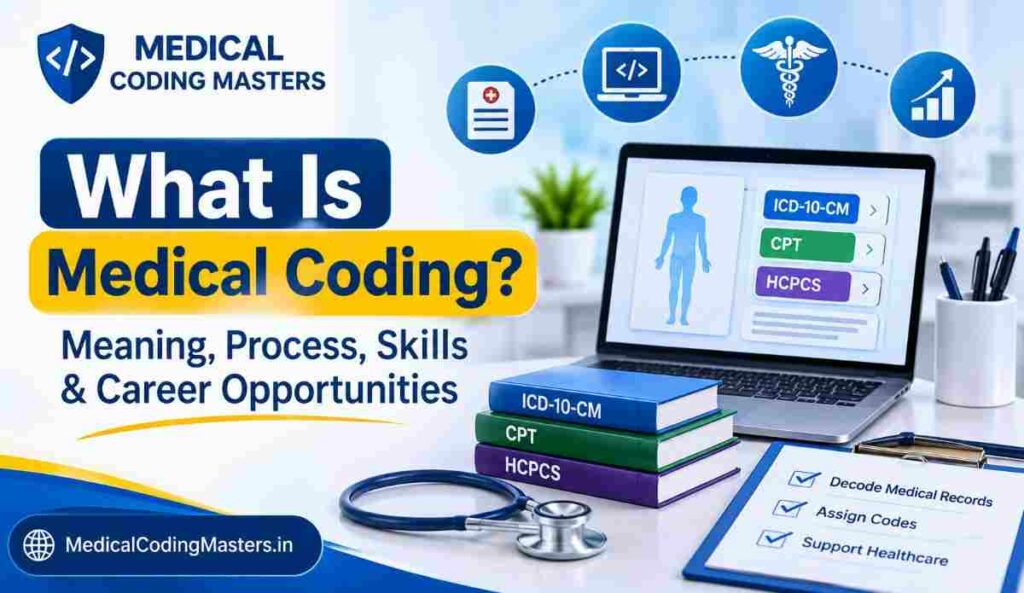
Medical coding is the process of converting patient medical records, diagnoses, procedures, and healthcare services into standardized alphanumeric codes. It helps hospitals and healthcare organizations maintain accurate records, process insurance claims, and manage medical information efficiently. Medical coding relies on established classification frameworks such as ICD-10-CM for diagnoses, CPT for medical procedures, and HCPCS for healthcare-related services and supplies. 

Medical coding is a growing career option for graduates interested in healthcare documentation, medical terminology, and analytical work.

✍️ Medical Coding Masters editorial team

Prefer a guided path?

Our trainers help you build the skills that lead to a better first offer. Sit in on a class for free.

Book a free demo
Introduction

What Is Medical Coding

Healthcare professionals play an important role in diagnosing diseases, treating patients and maintaining medical records. However, patient care involves more than consultations, laboratory tests and medications. Every healthcare service must also be properly documented and classified so that medical information can be understood, processed and communicated accurately.

This is where medical coding becomes important.

Medical coding is an essential part of the healthcare administration and revenue cycle management process. It helps convert information from patient medical records into standardized codes representing diagnoses, procedures and healthcare services.

Today, medical coding has become an interesting career option for graduates interested in healthcare documentation, medical terminology and analytical work. Students from life science, pharmacy, nursing and other educational backgrounds often explore this profession because it combines medical knowledge with technical accuracy.

In this article, we will understand what medical coding is, how it works, the different code classification systems, the responsibilities of medical coders, required skills and career opportunities.

What Is Medical Coding?

Medical coding is the process of converting medical information documented by healthcare professionals into standardized alphanumeric codes.

When a patient visits a hospital or clinic, the doctor records information about the patient’s symptoms, diagnosis, medical history, investigations and treatment. A medical coder reviews this documentation and identifies the appropriate codes according to established coding guidelines.

These codes represent important healthcare information in a consistent format.

For example, a patient’s medical record may contain information about:

  • The disease or medical condition diagnosed.
  • Symptoms reported by the patient.
  • Diagnostic tests performed.
  • Medical procedures carried out.
  • Treatments and healthcare services provided.

A trained medical coder reviews the available documentation and assigns the appropriate codes based on the applicable classification system.

In simple words: Medical coding means translating information from medical records into standardized codes that healthcare organizations use for documentation, reporting, claims processing and analysis.

Medical coding requires attention to detail because even a small coding error can affect claim processing, reporting accuracy and compliance.

Why Is Medical Coding Important in Healthcare?

Medical coding supports several activities within the healthcare industry. It creates a standardized method of representing medical information and helps different healthcare departments work with consistent data.

Here are the major reasons medical coding is important.


1. Standardization of Medical Information

Doctors and healthcare professionals may describe the same medical condition using different clinical terms. Standardized coding systems help represent these conditions consistently.

This makes medical information easier to organize, retrieve and analyze.


2. Accurate Insurance Claim Processing

In healthcare systems that use insurance reimbursement, diagnosis and procedure codes communicate information about the services provided to patients.

Insurance companies and other payers use submitted coding information as part of their claim review and payment processes.


Incorrect codes may result in claim rejections, denials or requests for additional documentation.


3. Maintaining Medical Records

Hospitals and healthcare organizations maintain large volumes of patient information.

Medical coding helps organize important clinical details so authorized healthcare professionals can retrieve and review information when needed.


4. Healthcare Data Analysis

Standardized medical information supports research, healthcare reporting and statistical analysis.

Organizations can use coded information to study disease patterns, treatment utilization and healthcare trends.


5. Compliance and Documentation Accuracy

Medical coders must follow applicable coding guidelines and documentation requirements.

Accurate coding helps healthcare organizations maintain appropriate records and reduce compliance-related risks.

Like what you see so far?

Attend a free live demo class with our trainers before you decide.

How Does Medical Coding Work?

Medical coding follows a systematic process. A coder cannot simply select a code based on a patient’s symptoms or personal assumptions. The code must be supported by the available medical documentation and applicable guidelines.

Let’s understand the process step by step.


Step 1: Review Patient Medical Records

The process begins when the medical coder receives patient documentation.

Depending on the healthcare setting, records may include:

  • Physician consultation notes.
  • Discharge summaries.
  • Laboratory reports.
  • Diagnostic imaging reports.
  • Operative reports.
  • Treatment documentation.

The coder reviews the information to understand the patient’s medical condition and the services provided.


Step 2: Identify Relevant Medical Information

After reviewing the documents, the coder identifies the documented diagnoses, procedures and other reportable services.

Understanding medical terminology, anatomy and physiology helps the coder interpret clinical documentation correctly.


Step 3: Identify the Appropriate Code Set

Different types of medical information require different coding classification systems.

For example:

  • ICD-10-CM is used for diagnosis coding in the United States.
  • CPT is used to represent many medical procedures and professional services.
  • HCPCS Level II represents certain supplies, products and services.

The appropriate system depends on the healthcare setting and the information being coded.

Step 4: Apply Coding Guidelines

Medical coders consult official coding guidelines, code descriptions, instructional notes and other applicable references.

They must also understand code sequencing, exclusions, inclusion notes and other coding conventions.

Step 5: Verify the Assigned Codes

Before completing the coding process, the coder checks whether the selected codes accurately represent the documented information.

If documentation is unclear or incomplete, the coder follows the organization’s clarification process rather than making assumptions.

Step 6: Complete the Coding Record

Once the codes are verified, they are entered into the appropriate healthcare information or coding system.

The completed information may then be used in claim preparation, reporting and other administrative processes.


What Are the Different Types of Medical Coding Systems?

Medical coding uses different classification systems depending on the purpose of the code and the healthcare environment.

For candidates learning medical coding for US healthcare accounts, understanding ICD-10-CM, CPT and HCPCS is particularly important.


1. ICD-10-CM (International Classification of Diseases, Tenth Revision, Clinical Modification)

ICD-10-CM is a classification system used to represent diseases, injuries, medical conditions and other diagnostic information in the United States.

It helps healthcare organizations classify patient diagnoses consistently.

Examples of information covered include:

  • Diabetes.
  • Hypertension.
  • Respiratory conditions.
  • Digestive system disorders.
  • Injuries and fractures.
  • Infectious diseases.

Medical coders use the Alphabetic Index and Tabular List, along with official guidelines, to identify and validate diagnosis codes.


2. CPT (Current Procedural Terminology)

CPT is a coding system maintained by the American Medical Association (AMA).

It is primarily used to describe medical procedures and professional services performed by healthcare providers.

Examples include:

  • Medical consultations.
  • Surgical procedures.
  • Diagnostic services.
  • Laboratory services.
  • Evaluation and management services.

CPT coding requires knowledge of procedure descriptions, code selection rules and applicable modifiers.


3. HCPCS (Healthcare Common Procedure Coding System)

HCPCS is used to identify healthcare products, supplies, services and certain procedures.

It has two levels:

HCPCS Level I: Consists of CPT codes maintained by the AMA.HCPCS Level II: Covers items and services such as certain medical supplies, durable medical equipment and ambulance services.

Medical coders must understand when HCPCS codes are applicable and how they relate to other coding systems.


4. ICD-10-PCS (International Classification of Diseases, Tenth Revision, Procedure Coding System)

ICD-10-PCS is used to classify inpatient hospital procedures in the United States.

It is different from ICD-10-CM, which represents diagnoses.

ICD-10-PCS uses a structured seven-character code format. Each character represents a specific aspect of the procedure.


Important: These systems are discussed in the context of US healthcare coding. Other countries may use different national coding standards and reporting requirements.

What Is the Difference Between Medical Coding and Medical Billing?

Medical coding and medical billing are closely connected, but they are not the same activity.

Medical coding focuses on reviewing clinical documentation and assigning appropriate standardized codes.

Medical billing focuses on preparing, submitting and following up on claims to obtain payment for healthcare services.

Medical Coding

Medical Billing

Reviews patient medical records.

Reviews patient and insurance information.

Identifies diagnoses and procedures.

Prepares and submits claims.

Assigns appropriate medical codes.

Processes claim-related information.

Uses ICD-10-CM, CPT and HCPCS.

Uses coding information for claim submission and follow-up.

Focuses on coding accuracy.

Focuses on payment and claim resolution.

Both functions work together to support an effective healthcare revenue cycle.

Need help choosing a path?

Talk to a counsellor about batches, fees and certification.

What Does a Medical Coder Do Every Day?

A medical coder’s daily responsibilities depend on the employer, healthcare specialty and type of coding assignment.

However, some responsibilities are common across many medical coding positions.

Major Responsibilities

  1. Reviewing Clinical Documentation

Medical coders examine patient charts and healthcare documents to understand the services provided.


  1. Assigning Diagnosis Codes

They identify documented medical conditions and assign appropriate diagnosis codes using the applicable classification system.


  1. Assigning Procedure Codes

They review procedure documentation and identify the correct codes based on the relevant guidelines.


  1. Following Coding Guidelines

Coders must stay updated with applicable coding conventions, annual code updates and organizational policies.


  1. Checking Coding Accuracy

They verify code selection, sequencing and supporting documentation before completing the assigned records.


  1. Handling Documentation Queries

When clarification is necessary, coders follow the approved process for obtaining additional information from healthcare providers.


  1. Maintaining Productivity and Quality

Medical coders are generally expected to maintain accuracy while meeting their organization’s productivity and turnaround-time requirements.

What Skills Are Required to Become a Medical Coder?

Medical coding is a knowledge-based profession. Candidates need to understand medical concepts and apply coding guidelines accurately.

Here are some important skills to develop.


1. Medical Terminology

Medical terminology is the language used to describe diseases, symptoms, body parts and medical procedures.

Learning common medical terms helps candidates understand clinical documentation.


2. Human Anatomy and Physiology

Anatomy explains the structure of the human body, while physiology explains how different body systems function.


This knowledge helps medical coders understand diagnoses and procedures.


3. ICD-10-CM Knowledge

Candidates should understand diagnosis coding conventions, chapter-specific guidelines, code selection and sequencing.


4. CPT and HCPCS Knowledge

Understanding procedure coding is essential for many outpatient and professional coding assignments.


5. Analytical Thinking

Medical coders must carefully interpret documentation, identify relevant details and select codes according to established rules.


6. Attention to Detail

Accuracy is one of the most important qualities in this profession. Coders must carefully review documentation and avoid unsupported code assignments.


7. Computer Knowledge

Basic computer skills and familiarity with electronic medical records, coding applications and healthcare software can help candidates work efficiently.

Who Can Learn Medical Coding?

Medical coding can be explored by graduates from different educational backgrounds, depending on the employer’s eligibility requirements.

Some common educational backgrounds include:

  • B.Sc. Life Sciences.
  • B.Sc. Biotechnology.
  • B.Sc. Microbiology.
  • B.Sc. Nursing.
  • B.Pharmacy.
  • Pharm.D.
  • BDS.
  • MBBS.
  • Other relevant healthcare and science qualifications.

Candidates without a traditional medical degree may also explore training opportunities, although eligibility for individual jobs varies.

The most important preparation areas include medical terminology, anatomy, physiology and coding guidelines.

Want to see how we teach?

Sit in on a real class and ask your questions.

Is Medical Coding a Good Career Option?

Medical coding can be a suitable career option for people who enjoy healthcare-related work, documentation, research and analytical tasks.


The profession offers opportunities across different healthcare organizations and revenue cycle management companies.


Some reasons candidates consider this career include


  • Opportunities to work with international healthcare documentation.
  • Different coding specializations.
  • Professional certification pathways.
  • Opportunities to develop healthcare knowledge.
  • Potential career progression into auditing, quality and team leadership.
  • Opportunities for experienced professionals in certain remote and hybrid roles.

However, medical coding is not an easy job that requires only memorizing codes. Candidates must understand documentation, apply coding rules and maintain accuracy.


Career opportunities and salary levels depend on educational qualifications, practical knowledge, certification, experience and employer requirements.

What Are the Career Opportunities in Medical Coding?

After developing the required knowledge and practical skills, candidates can explore different positions in the healthcare industry.


Some common career roles include


1. Medical Coding Trainee

A beginner-level position where candidates learn coding workflows and work under supervision.


2. Medical Coder

Reviews patient documentation and assigns appropriate diagnosis and procedure codes.


3. Senior Medical Coder

Handles more complex coding assignments and may support junior team members.


4. Coding Auditor

Reviews coded medical records to identify errors, check compliance and improve coding quality.


5. Coding Quality Analyst

Monitors coding accuracy, productivity and quality performance.


6. Coding Trainer

Provides training to new candidates and helps them understand medical coding concepts and guidelines.


7. Coding Team Leader or Manager

Manages coding teams, monitors performance and coordinates daily operations.

If you want to understand how these positions connect and how professionals progress from entry-level roles, explore our guide on Medical Coding Jobs in Hyderabad.

What Is the Importance of Medical Coding Training?

Learning medical coding requires a structured approach because different concepts are connected.

For example, understanding medical terminology makes it easier to interpret patient records. Anatomy and physiology provide the clinical foundation, while coding guidelines help candidates assign the correct codes.


A structured training programme can help learners develop these skills in the correct sequence.

Important areas to cover during medical coding preparation include


  1. Introduction to healthcare systems.
  2. Medical terminology.
  3. Human anatomy and physiology.
  4. ICD-10-CM guidelines.
  5. Diagnosis coding across different body systems.
  6. CPT coding.
  7. Evaluation and Management (E/M).
  8. Medical coding modifiers.
  9. Specialty coding.
  10. HCPCS Level II.
  11. Practical case studies.
  12. Certification examination preparation.

For a detailed breakdown of the topics, modules and learning stages, read our Medical Coding Course Syllabus.

Ready to start learning?

The next batch starts on 17th November 2026.

How to Start Learning Medical Coding?

If you are a beginner and want to enter this profession, follow a step-by-step learning approach.

Step 1: Understand Healthcare Basics

Learn how hospitals, clinics, healthcare providers and insurance organizations work.

Step 2: Study Medical Terminology

Start with prefixes, suffixes, root words and commonly used medical abbreviations.

Step 3: Learn Anatomy and Physiology

Understand the major body systems and their functions.

Step 4: Understand ICD-10-CM

Begin with coding conventions and gradually practise diagnosis coding across different chapters.

Step 5: Study CPT and HCPCS

Learn how medical procedures, professional services and healthcare supplies are classified.

Step 6: Practise Medical Records

Work with sample clinical documentation and case-based coding exercises.

Step 7: Prepare for Certification

Explore relevant certification options, such as CPC, CCS and CCA, depending on your intended career path. Check the respective certification organization’s eligibility and examination requirements.

Step 8: Prepare for Job Interviews

Revise coding concepts, practise sample questions and improve your ability to explain coding decisions.

Learn Medical Coding with Medical Coding Masters

Medical Coding Masters provides structured medical coding training for candidates who want to develop practical knowledge and prepare for opportunities in the healthcare industry.

The programme is designed to take learners from foundational concepts to advanced coding topics through a structured curriculum.


What You Can Learn

  • Medical terminology and human anatomy.
  • ICD-10-CM diagnosis coding.
  • CPT and E/M coding.
  • HCPCS Level II.
  • Specialty-based coding concepts.
  • Coding guidelines and conventions.
  • Practical case studies.
  • CPC, CCS and CCA mock examination practice.

Training Features

  • 28 structured learning modules.
  • Three-month training programme.
  • Classroom training near JNTU Metro Station, Hyderabad.
  • Live online learning options.
  • Self-paced learning resources.
  • Practical coding exercises.
  • Trainer guidance and doubt clarification.
  • Resume and interview preparation support.

If you are planning to begin your medical coding journey, visit Medical Coding Masters to explore the course and available training options.


You can also attend a free demo class to understand the teaching approach before deciding to enrol.

Conclusion

Medical coding is an important healthcare process that converts clinical documentation into standardized codes representing diagnoses, procedures and medical services. It supports healthcare documentation, insurance claim processing, reporting and data analysis.


For beginners, understanding medical terminology, anatomy, ICD-10-CM, CPT and HCPCS is an important starting point. Practical exercises and knowledge of coding guidelines help learners develop the accuracy required for professional work.


Medical coding can offer different career opportunities for candidates who are willing to build their knowledge and continuously improve their skills.


With structured learning, practical preparation and relevant certification, aspiring candidates can work towards building a career in the medical coding industry.

Questions about the course?

Call or WhatsApp +91 81868 44555 for fees and batch timings.

STILL WONDERING?

FAQ

1. What is medical coding in simple words?

Medical coding is the process of converting information from patient medical records into standardized codes representing diagnoses, procedures and healthcare services.

2. Why is medical coding used in hospitals?

Medical coding helps hospitals organize clinical information, prepare insurance claims, maintain records and support healthcare reporting and analysis.

3. Is medical coding a technical or medical job?

Medical coding is a healthcare-related administrative and analytical profession. It requires medical knowledge, documentation skills and an understanding of coding guidelines.

4. What are the three main coding systems used in US medical coding?

The three commonly used systems are ICD-10-CM for diagnoses, CPT for procedures and professional services, and HCPCS Level II for certain healthcare supplies and services.

5. Can freshers learn medical coding?

Yes. Freshers can learn medical coding through structured training, medical terminology, anatomy, coding guidelines and practical exercises. Job eligibility depends on individual employer requirements.

6. Which degree is suitable for medical coding?

Life science, biotechnology, microbiology, nursing, pharmacy and other healthcare-related degrees can be relevant. Individual employers may have different educational requirements.

7. Is medical coding difficult to learn?

Medical coding may be challenging initially because learners must understand medical terminology, anatomy and coding conventions. Regular practice and structured learning can make the concepts easier to understand.

8. What is ICD-10-CM in medical coding?

ICD-10-CM is a standardized classification system used in the United States to represent diagnoses, diseases and medical conditions.

9. What is the difference between ICD-10-CM and CPT?

ICD-10-CM represents diagnoses and medical conditions, whereas CPT describes medical procedures and professional services.

10. Do medical coders need certification?

Certification is not mandatory for every medical coding position, but employers may require or prefer professional credentials. CPC, CCS and CCA are examples of relevant certifications.

11. Can non-medical graduates learn medical coding?

Some non-medical graduates may access training programmes, but employment eligibility varies by organization. A strong understanding of medical terminology, anatomy and coding guidelines is important.

12. What is the first subject to learn in medical coding?

Medical terminology is a good starting point, followed by anatomy and physiology. These subjects provide the foundation for understanding clinical documentation and coding rules.

13. Is medical coding and medical billing the same?

No. Medical coding assigns standardized codes to clinical information, while medical billing manages the claim submission and payment follow-up process.

14. Where can I learn medical coding in Hyderabad?

Medical Coding Masters offers medical coding training in Hyderabad, with classroom, live online and self-paced learning options. Students can explore the syllabus and attend a free demo class before enrolling.

Enroll For Medical Coding Free Demo Class